Lisa-Marie Gagliardi
Pedagogist • Professor • PhD Candidate
my teaching philosophy


Teaching, for me, is ethical and relational work where curriculum, care, and more‑than‑human worlds converge. In my courses, students are invited to develop an attentive practice, to notice what is happening in an encounter, to listen for what is at stake, and to respond with care. Early childhood curriculum is made in the everyday, through gestures, materials, stories, routines, and the more‑than‑human worlds children inherit and help shape. Practicing this kind of attention matters because it helps us recognize that pedagogy is happening in the everyday, and that how we respond shapes the worlds children come to know.
My teaching is interdisciplinary and deliberately resists the comfort of tidy answers. I bring curriculum studies into conversation with reconceptualist early childhood scholarship, feminist and environmental humanities, food pedagogies, and arts‑based approaches to learning. This interdisciplinarity isn’t about adding more content; it’s about widening what becomes thinkable. Students learn to recognize how “common sense” in early childhood education is often shaped by policy, regulation, developmental certainty, and efficiency. These are the forces that quietly govern what becomes noticeable, sayable, and doable in practice.
In the Canadian context, I take seriously ongoing responsibilities to unsettle Euro‑Western defaults in education. I center Indigenous scholarship and ways of knowing, and the work of racialized, feminist, and 2SLGBTQ+ scholars and practitioners, not as an add‑on, but as essential to thinking about land, relations, accountability, and what it means to learn well together. I also work with students to develop citational care by paying attention to whose ideas we build with, what we carry forward, and how our learning practices can reproduce, or refuse, hierarchies of knowledge.
A common thread across my teaching is weaving theory and practice through inquiry. I don’t treat theory as something abstract that students “apply” later. Instead, we use theory as a companion for noticing, and a way to slow down interpretation, ask better questions, and examine how curriculum is made through relationships and context. My classes often include documentation practices, studio‑style learning with materials, close reading and collective discussion, and reflective writing that returns to ordinary moments and makes them available for deeper thought. Readings are approached as situated ideas, meant to be grappled with together rather than extracted for quick conclusions.
Assessment in my courses is designed as an invitation to think, rather than tasks to complete. Whenever possible, students can demonstrate learning across modes (writing, visual composition, audio/video work, and pedagogical documentation) so the form supports the thinking. In this way, flexibility is paired with clarity. Learning outcomes and shared criteria remain steady, while students’ pathways into the work can be responsive to their interests, responsibilities, and ways of making meaning. My goal is for students to leave with more than strategies; I want them to cultivate a pedagogical awareness that prioritizes care, complexity, and accountability in the worlds they will teach within.

my pedagogical commitments
These commitments guide how I design learning spaces, choose texts, structure assignments, and respond to what emerges in the room.
Relational, more-than-human pedagogy
I study learning as something co-composed with children, educators, materials, land, and food, attending to interdependence, responsibility, and everyday world-making.
Ethical, situated inquiry
My work stays close to practice and its tensions, taking up feminist and postfoundational approaches (in dialogue with Indigenous scholarship) to resist quick fixes and remain accountable to context, power, and difference.
Slow, collaborative curriculum-making
I value co-labouring with educators through documentation, collective reflection, and iterative experimentation, treating curriculum as an ongoing practice of noticing, responding, and redoing.

Teaching Areas
My teaching sits at the intersections of curriculum studies and early childhood education, with an emphasis on inquiry, ethics, and material practices. Across courses, I return to questions of how curriculum is made in relation, and how educators cultivate a pedagogical awareness in complex, living contexts.
Curriculum studies • Pedagogical documentation • Studio/material practices • Food pedagogies • Relational ethics • Equity • More-than-human worlds
In the Classroom
In my courses, learning is organized around a few practices we return to throughout the term. Studio and seminar formats work together, so making and critical discussion are held side by side. Students learn to think with concepts through shared dialogue, close reading, and collaborative work, rather than treating content as something to get through.
Documentation is central to this approach. Not as proof, and not as compliance, but as a way of slowing down and revisiting moments with care. We use documentation to ask better questions about what happened, what became noticeable, and how curriculum takes shape in relation. Assessment supports this same orientation. Students are often able to work across modes, including writing, visual and digital composition, and documentation, so that the form strengthens the thinking. Where it makes sense, formats can be adapted to meet shared outcomes, especially when flexibility creates better conditions for learning.

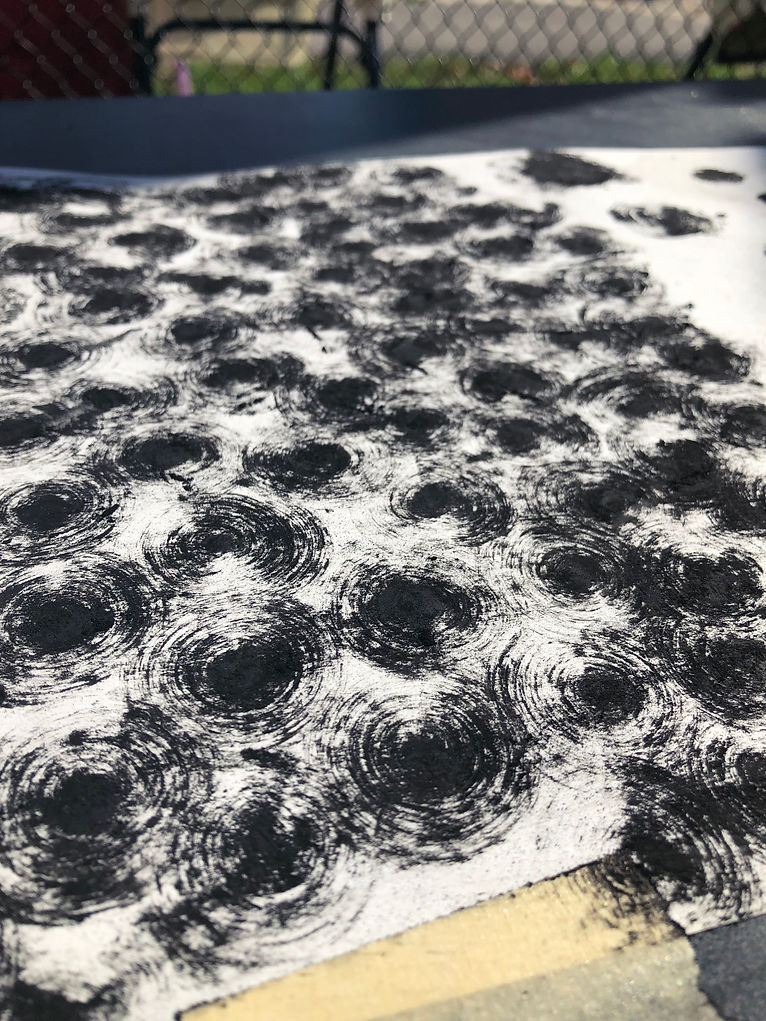
Studio inquiry + collaborative documentation
In my art courses, students often learn through studio-based inquiry: working with materials, noticing what emerges, and tracing how meaning is made in relation. Documentation is central, not as proof of learning, but as a way of slowing down and revisiting moments with care. Students use photographs, notes, and dialogue to compose documentation that makes their learning visible, and we return to it together to ask:
What became noticeable?
What stayed difficult?
What is this moment asking of us as educators?
Responsive assessment and co-designed formats
I design assessments as invitations to think, not tasks to complete. Whenever possible, students can work across various modes (i.e. writing, visual and digital composition, documentation, reflective analysis), so that the form supports the thinking. I also build in room for responsiveness: when a student needs a different format to meet shared outcomes, we can often co-design an alternative that honours both the integrity of the course and the student’s way of making meaning. This flexibility consistently opens deeper engagement and more careful work.
Everyday arts of noticing
I bring “the arts of noticing” into teaching as a practice that can travel beyond the classroom. Sometimes this looks like small field notes: paying attention to a routine, a gesture, a soundscape, a seasonal change. And then returning to what was observed to ask what it might mean pedagogically. In my own life as a mother, I practice this kind of slow attention with my children, especially in ordinary encounters with the more-than-human life around us. It reminds me that curriculum begins in how we learn to notice, respond, and live well together.

A formative professional learning moment for me was an evening of conversation with Professor Carlina Rinaldi, alongside Dr. Veronica Pacini-Ketchabaw, Dr. Laurie Kocher, and Dr. Sylvia Kind, in Reggio Emilia, Italy (August 2017). Experiences like this have shaped how I think about pedagogical documentation, curriculum-making, and the ethical work of teaching.
Professional Learning & Collaborations
I contribute to professional learning in early childhood communities and postsecondary programs through workshops, invited talks, and collaborative inquiry. This work is grounded in documentation practices, studio-based learning, and curriculum-making that stays with ethical complexity—particularly in relation to food, care, and more-than-human worlds.
As part of my professional learning work, I served as a Regional Coordinator for the Provincial Centre of Excellence for Early Years and Child Care, an Ontario-funded education initiative. In this role, I coordinated and facilitated learning alongside educators across Toronto and the GTA who were deepening their professional practice by learning the role of a Pedagogist. The work focused on building pedagogical awareness through collaborative inquiry, documentation, and sustained reflection, supporting educators to think beyond technique and toward pedagogical leadership.
Selected engagements
-
Continuous Professional Learning workshop on Inquiry-based curriculum (Denison Child Care Services), 2025
-
Invited talk on Centre of Excellence for Early Years and Child Care (Early Educators Leadership Conference), 2019
-
Study Visit: A seminar and exchange of ideas (Loris Malaguzzi International Centre, Reggio Emilia, Italy), 2018